Description
Nature’s Natural Filter Feeder! These are miracle workers and will clean your water!
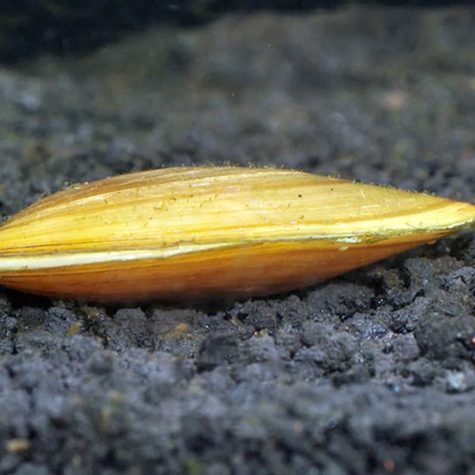
The Golden Batissa is a large, thick-shelled freshwater bivalve clam native to the tropical rivers and estuaries of the Indo-Pacific region. Commonly known as the Golden batissa, it holds significant ecological, culinary, and aquarium trade value.
Coloration: The exterior of the shell features a Golden yellow while the inside exhibits a striking, deep violet or purple mother-of-pearl nacre.
It is a heavy, robust, ovate clam with coarsely serrated lateral teeth and heterodont hinge teeth.Size: It averages 6 to 10 cm in length but can occasionally grow up to 15 cm which is rare.
Habitat & Distribution Range: Widely distributed throughout the tropical Indo-Pacific, including the Philippines, Malaysia, Indonesia, Fiji, Papua New Guinea, and Northern Australia.Environment: It primarily lives infaunally (burrowed deep in sand or mud) within the lower sections of rivers and freshwater-estuarine interfaces.
Resilience: It can survive drought periods by burrowing deep into sediment without surface access, feeding on subterranean water instead.
Diet & Feeding: It is a suspension and pedal deposit filter feeder. Its diet consists of 80–90% detritus mixed with microalgae, bacteria, and diatoms sieved from the water column.Reproduction: The species is dioecious (separate sexes) and non-brooding (oviparous), releasing eggs that develop into free-swimming larvae.
This clam is a highly sought-after food source across local markets. It is known as “Cabibi” or “Batitis” in the Philippines’ Cagayan River and “Kai” in Fiji’s Rewa River.Aquarium Care: Kept in home aquariums as the “blue/black cockle”
Using Clams as a natural water filterer in your aquarium offers quick, effective results for a balanced eco-system. Once you first get delivery of your clams, acclimate like you would a fish by floating the clam bag in your aquarium or pond, then slowly add some of your water to the bag, no need to take a long time to do this, perhaps less than 5 minutes, then just dump the bag into your tank. We generally only ship clams and snails with just a dribble of water in their bag so they do not get ammonia poisoning enroute in case they waste in the bag. You may gently push them into your substrate if you like, but they will figure out what and where they want to go over the next couple days.
NOTE: A closed clam is a happy ALIVE clam. A partially open shell is usually an indication of the clam trying to move around. An open shell indicates that the clam is Dead.
This item is restricted in IN, NY, WI
Min order no less than 3
We harvest a limited number of these clams each week so they sell out fast. If you can add to your cart, it’s in stock. If it says “out of stock” check back in a couple days. We restock each week.